Evalo
A browser extension for Chrome and Firefox that rates products in supported web shops with AI, filters out fake reviews and suggests alternatives that match what you're looking for.
- Type
- Competition project2nd place · School competition
- Tech stack
- TypeScript
- WebExtensions
- Vite
- OpenAI API
The idea
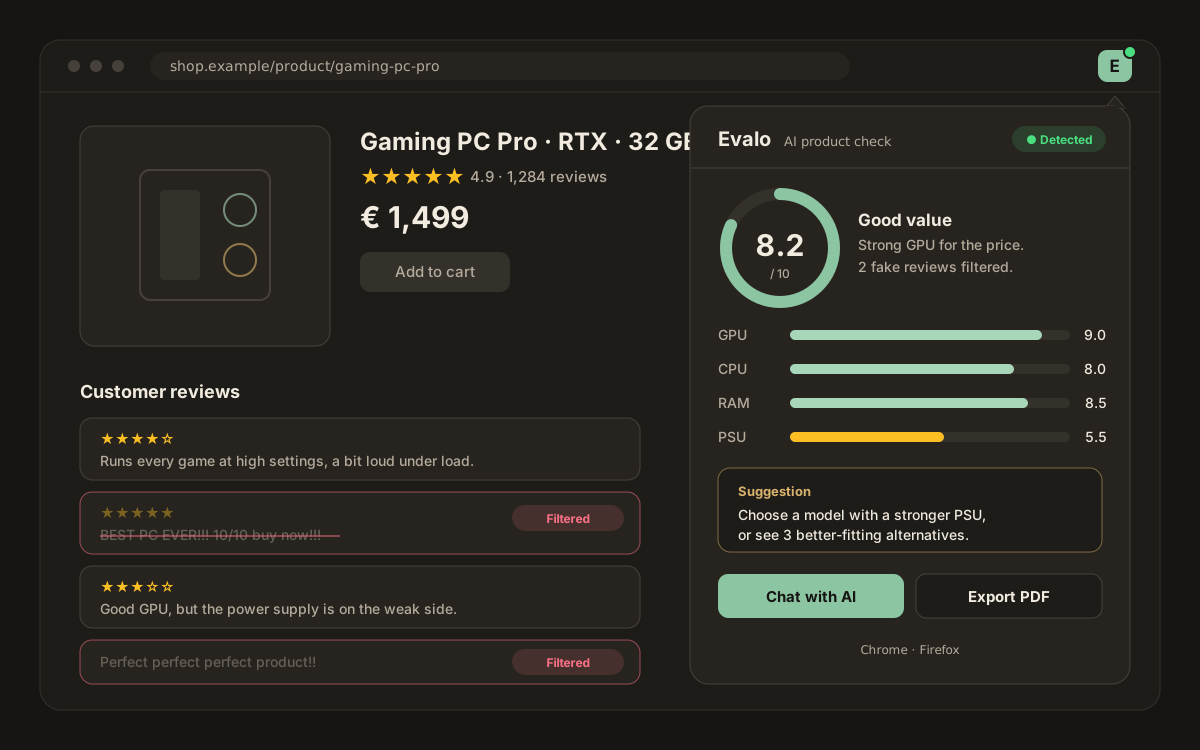
Shopping online means trusting product descriptions and reviews, and neither helps much. Specs are hard to judge without expert knowledge, and some reviews are paid for or fake. Evalo is a browser extension for Chrome and Firefox that rates a product right on its page in a supported shop.
I started with prebuilt PCs, because their components are especially hard to judge, and later added a generic parser for other product types.
What it does
On a product page in a supported shop (including Amazon.de, .com, .co.uk, .fr and .ca), Evalo reads the product data and reviews, leaves out reviews that look fake, and asks an AI for a verdict. You get an overall score from 0 to 10, sub-scores (for a PC: CPU, GPU, RAM and storage), a price-performance assessment, and alternatives that fit your needs better. Tests, comparisons and user reports from the web feed into the analysis too.
A chat answers follow-up questions like "Is this enough for video editing?", and the analysis can be saved or shared as a PDF.
How it's built
- Product pagecontent script
- Parserproduct data + reviews
- Background workerfilter · cache · API
- OpenAI APIrating + chat
- Popupresult · chat · PDF
The API key only lives in the background worker. Content scripts read the page and pass product data to the worker through messaging, so the shop page never sees the key. Results are cached locally, which saves API costs and makes repeat visits instant. Only product information goes to the AI, never anything about the user.
Each supported shop has its own parser. That's more work than trying to understand any page, but the data is far more reliable, and an AI's verdict is only as good as the data it gets. For the same reason, filtering out fake reviews mattered as much as the prompt.
Chrome (Manifest V3) and Firefox (Manifest V2) are built from the same TypeScript code, with the differences kept in the build.